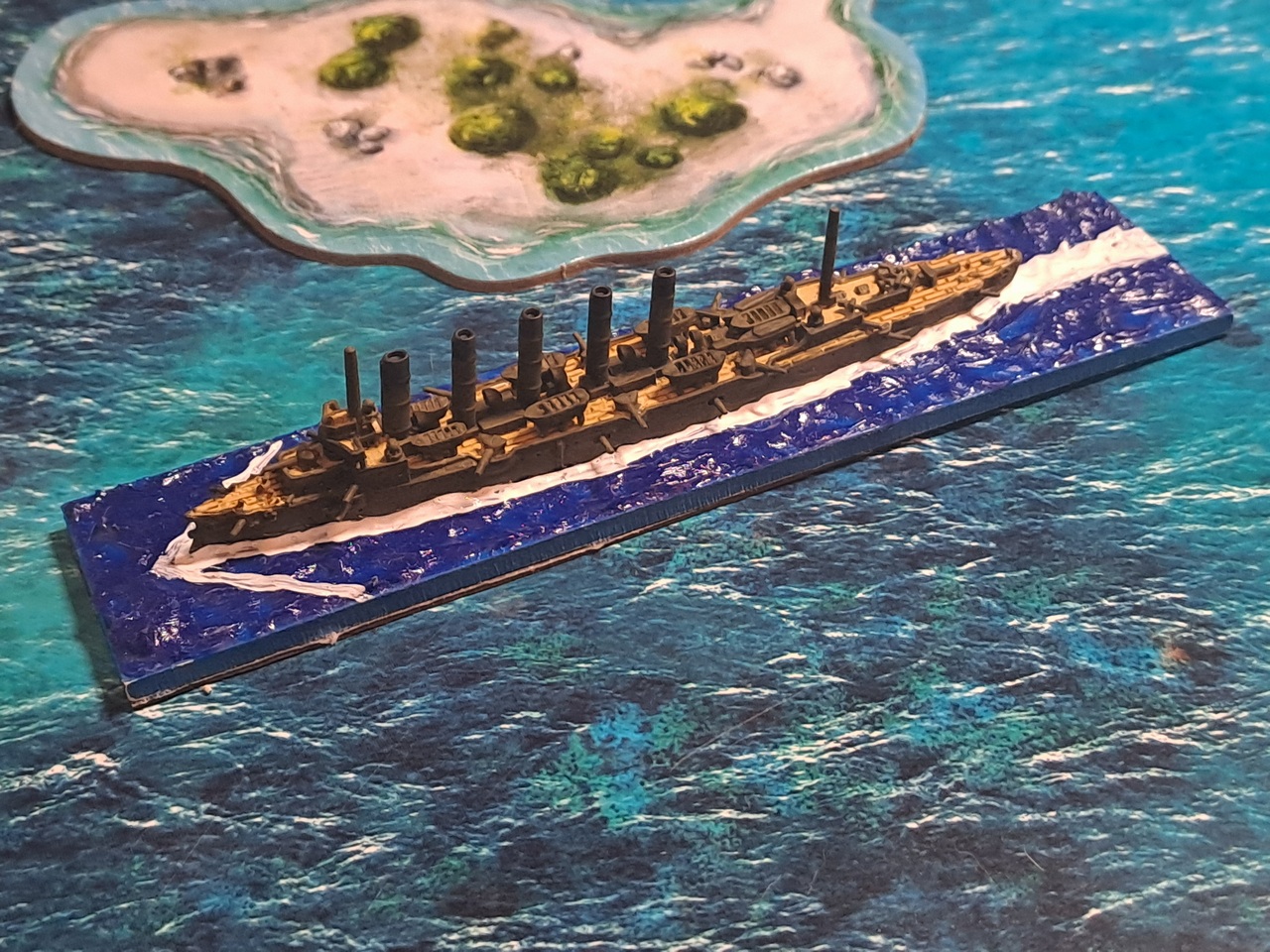
🇬🇧 Recently, I managed to finish the model of Askold painted in the scheme it wore in battle — that of the Port Arthur Squadron. It’s one of my favorite armored cruisers, alongside Varyag.
Askold was a protected cruiser built for the Imperial Russian Navy, named after the legendary Varangian ruler of Kiev. Her thin, narrow hull and maximum speed of 23.8 knots were considered impressive for the time. She had five thin funnels which gave her a unique silhouette for any vessel in the Imperial Russian Navy.
From the start of the Russo-Japanese War of 1904-1905, Askold was one of the most active vessels in the Russian fleet.
The cruiser’s high speed, durability, and good (for protected cruisers) armour characteristics make it a very useful ship in the player’s fleet, excelling in encounters with other cruisers and smaller vessels. Additionally, its unique 5-funnel silhouette will give it an unmistakable appearance on the gaming table.
* – description of the Askold by GMBoardgames.
🇵🇱 W ostatnim czasie udało mi się skończyć model Askolda w malowaniu w jakim walczył – czyli eskadry Port Artur, jeden z moich ulubionych obok Variaga krążowników pancernopokładowych.
Askold był krążownikiem pancernopokładowym zbudowanym dla Marynarki Wojennej Imperium Rosyjskiego, nazwanym na cześć legendarnego Warega. Jego cienki, wąski kadłub i maksymalna prędkość wynosząca 23,8 węzłów były uważane za imponujące jak na tamte czasy. Miał pięć cienkich kominów, co nadawało mu unikalną sylwetkę wśród okrętów Marynarki Wojennej Imperium Rosyjskiego.
Od początku wojny rosyjsko-japońskiej w latach 1904-1905, Askold był jednym z najbardziej aktywnych okrętów w rosyjskiej flocie. Wysoka prędkość, trwałość i dobre (jak na krążowniki pancernopokładowe) właściwości opancerzenia sprawiają, że jest to bardzo użyteczny okręt w flocie gracza, doskonały w starciach z innymi krążownikami i mniejszymi jednostkami. Dodatkowo, jego unikalna sylwetka z pięcioma kominami nada mu niezapomniany wygląd na stole do gry.
* – opis Askolda wg GMBoardgames.



🇬🇧 Summary:
– It’s a very fast cruiser, perfect for scenarios involving breaking out or maneuvering — and, of course, an excellent ship for ramming other vessels. I usually field it alongside the slightly lighter-armored but equally swift Varyag.
– more about Gods of War: Togo you can read HERE: https://www.gmboardgames.com/blog/bogowie-wojny-togo/. The game and everything related to it is available from the publisher, GM Boardgames that is, at the Bolter store: https://bolter.pl/en_US/index
🇵🇱 Podsumowanie:
– jest to bardzo szybki krążownik, idealny na scenariusze z wypływaniem oraz a jakże świetny okręt do taranowania innych jednostek. Na ogół zawsze wystawiam go z nieco lżej opancerzonym i równie szybkim Variagiem.
– więcej o Bogowie Wojny: Togo można przeczytać TUTAJ: https://www.gmboardgames.com/blog/bogowie-wojny-togo/ . Gra i wszystko z nią związane jest dostępna u wydawcy GM Boardgames czyli w sklepie Bolter: https://bolter.pl/pl/c/BOGOWIE-WOJNY-TOGO/1787
 tancreddebeauville

Nicely done! 🙂 Quite a distinctive looking ship with those five funnels! I always think of her as the „Packet of Woodbines”, the name she was referred to by British sailors!